


The High-End Client’s Anxiety: The Permanent Footprint
When investing in a custom, heavy-weight textile for a master suite or a formal living room, clients naturally want to ensure its longevity. A beautiful design looks flawless on day one. However, interior designers and premium homeowners frequently harbor an anxiety about placing heavy furniture on rug surfaces. Will a heavy solid-timber bed frame, a marble coffee table, or a deep-seated sofa ruin the beautiful pile forever?
We have all seen the casualty of cheap retail carpeting. Deep, crushed, permanent craters remain behind after moving a piece of furniture just a few centimeters. Consequently, it disrupts the room’s flow. It also makes rearranging a space impossible without exposing unsightly damage.
Fortunately, permanent fiber crushing is not an inevitability. It is simply a consequence of cheap material engineering. By understanding the structural science of high-end fiber matrices, you can safely position heavy furniture on rug canvases. As a result, you will know the yarn will bounce back perfectly when your room layout shifts.
The Molecular Memory of Wool
The secret to a textile that resists permanent crushing lies deep within the molecular structure of the yarn itself. Cheap synthetic fibers, such as polyester or polypropylene, are extruded as straight, smooth plastic tubes. When a heavy sofa leg applies continuous pressure, these plastics flatten. Therefore, they experience permanent deformation. The structural memory breaks, locking the flat indentation in place permanently.
In contrast, our studio relies on a premium composition of 80% wool and 20% nylon to protect against the weight of heavy furniture on rug layouts. At a microscopic level, wool behaves entirely differently than synthetic plastic:
-
The Natural Spring (The Helix Structure): Wool fibers possess a natural three-dimensional crimp. The protein chains inside the fiber form a helical spring shape. When a heavy furniture post compresses the pile, this helix acts like a mechanical spring to absorb the load without breaking.
-
Moisture-Driven Elasticity: Wool contains a natural cellular core that absorbs moisture vapor from the air. Because of this, ambient moisture acts as a natural plumping agent. This gives the fiber incredible elasticity to push back smoothly against crushing forces.
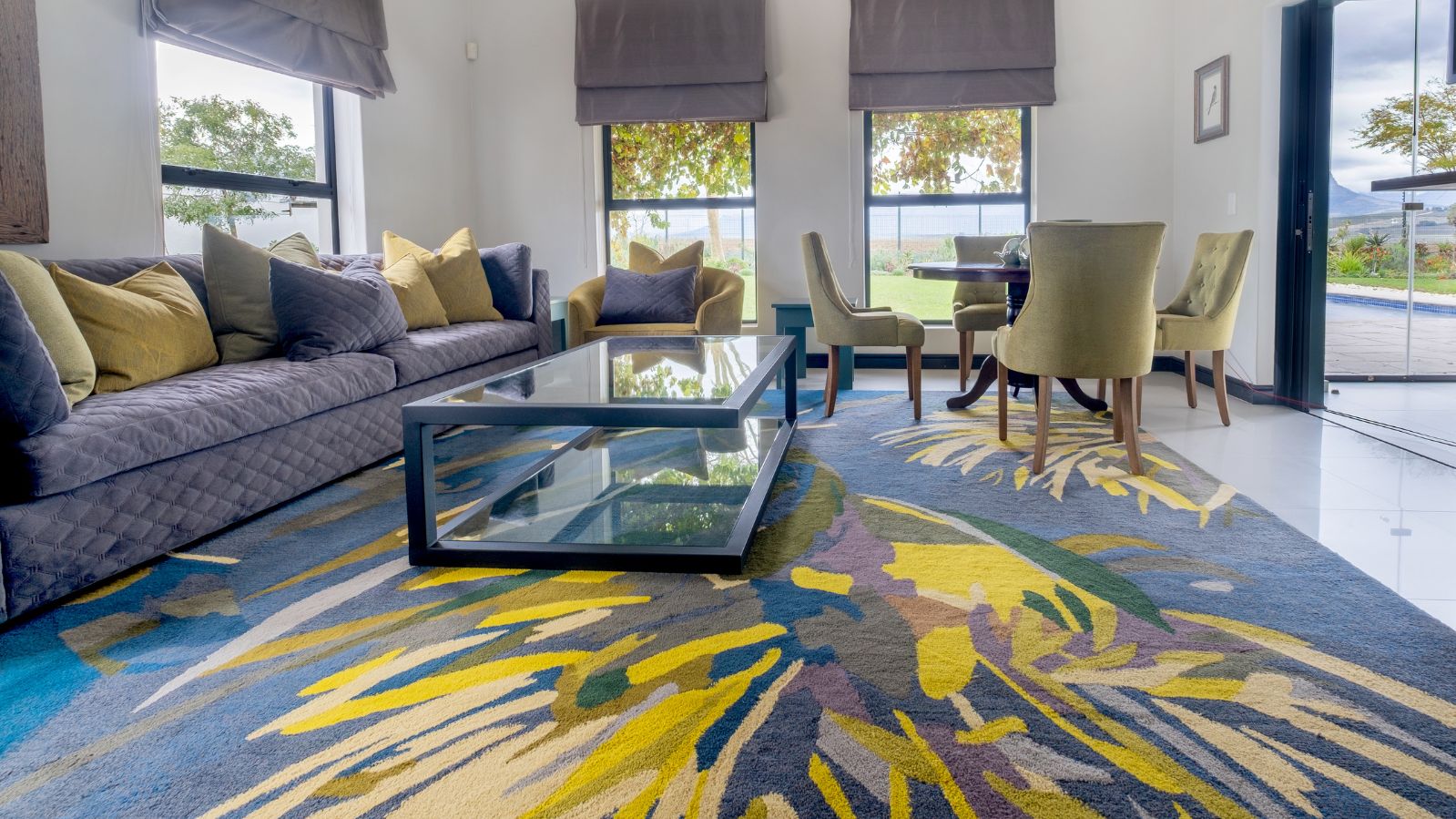
The Structural Response to Heavy Furniture on Rug Layouts
Pure wool is an incredible natural performer. However, blending it with 20% high-performance nylon creates an unbeatable textile alliance. Nylon is the strongest of all fully synthetic fibers. In an 80/20 premium blend, it provides essential structural reinforcement without sacrificing tactile luxury.
When heavy structural columns, bed posts, or steel-framed daybeds apply intense, localized pressure, the nylon strands provide crucial elastic tensile strength. Therefore, they help the wool spring back smoothly. This prevents the individual yarn tufts from fraying or spreading out under sheer weight, ensuring long-term durability.
Why 5kg/m² Density Prevents Subfloor “Bottoming Out”
Fiber composition is only half the battle. In addition, the actual yarn mass determines how weight distributes across the floor. A standard retail area rug is often tufted loosely. This leaves gaps of empty air between the yarn rows. When a heavy object sits on a low-density pile, the individual strands simply collapse sideways into the empty gaps. Consequently, they bottom out completely against the hard subfloor backplate.
Tufting to a substantial density of 5kg of yarn per square meter completely changes the physics of load-bearing.
Because our yarn strands are packed tightly together, they cannot fall sideways. They are forced to stand upright. They support one another like a dense, vertical column matrix. As a result, the weight of your interior styling elements distributes evenly across thousands of tightly compacted wool helices. This minimizes the severity of the initial indentation.
Studio Secret: How to Revive a Compressed Pile
Even with a premium 80/20 wool-nylon blend, a heavy object sitting in the exact same spot for years will cause the fibers to temporarily compress. When you decide to shift your layout, you can instantly accelerate the fiber’s natural spring memory with a simple studio trick:
-
Moisturize the Helix: Place a clean, damp cotton cloth directly over the indentation.
-
Apply Gentle Heat: Pass a warm clothing iron lightly over the cloth for a few seconds. Crucially, never touch the iron directly to the bare yarn. The rising steam penetrates the wool’s cellular core, instantly triggering the protein bonds to return to their original, upright helix shape.
-
Brush and Release: Remove the cloth and gently lift the dense pile using a coin or a soft bristle brush. Soon, the fibers will bounce back seamlessly into the rest of the canvas.
Designing for Ever-Changing Spaces
Bespoke residential interiors are living environments that evolve over time. Therefore, you should have the complete freedom to rearrange your master suite. You can rotate your living room layout or update your styling without being restricted by permanent scars on your floor.
By investing in an engineered textile matrix—combining the natural spring of wool, the resilience of nylon, and a dense, structural tuft—you ensure your rug remains a flawless, permanent asset to your home’s architecture.
Explore our portfolio of custom residential installations to see how our heavy-density pieces hold up in premium spaces, or connect with our studio directly to arrange a complimentary design consultation.