


Elevating the Master Suite: A Guide to Bespoke Bedroom Textiles
The master bedroom is the ultimate architectural sanctuary within a home—a highly private space designed intentionally for rest, decompression, and absolute comfort. When customising this space, selecting the right floor rug requires a careful balance of aesthetic vision and spatial awareness. A beautifully crafted textile can easily lose its impact if its scale conflicts with the structural boundaries of the room.
Interior designers frequently ask: What is the rule of thumb for bedroom layouts? The answer relies entirely on how you want to frame the bed, anchor the surrounding furniture, and interact with the floor space when you first wake up.
The Three Definitive Placement Frameworks
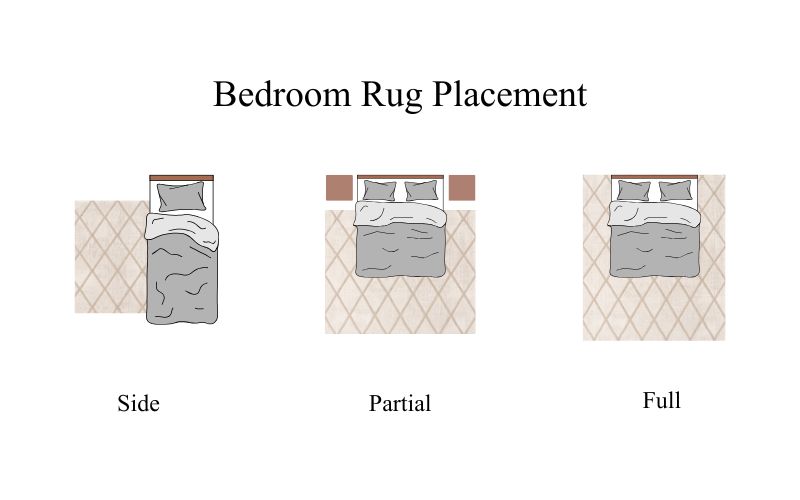
To establish a clean, proportioned foundation underfoot, designers generally rely on three classic placement methodologies, as illustrated in our placement guide. Each framework alters the visual weight of the room and dictates the exact dimensions your custom piece will require.
-
The Full Layout: In large, high-ceilinged master suites, the most cohesive approach is to place the entire bed, headboard, and flanking bedside tables completely on top of the textile canvas. This layout creates an incredibly grounded, hotel-tier aesthetic. To execute this correctly, the perimeter must extend roughly 60cm to 90cm beyond the outer edges of the furniture footprint, ensuring a continuous perimeter of visible luxury.
-
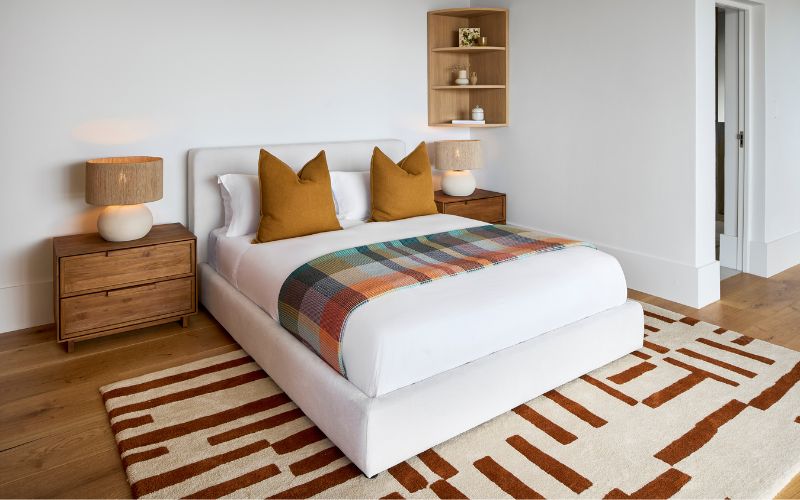
The Partial Layout: The partial frame is the most widely utilised layout in contemporary interior architecture. The textile sits horizontally underneath the lower two-thirds of the bed, stopping just short of the bedside tables. This leaves the head of the bed resting directly on the hard flooring while ensuring that when you step out of bed, your feet land entirely on a plush, warm surface.
-
The Side Layout: For asymmetrical spaces, narrow layouts, or rooms featuring beautiful structural hardwood floors that you prefer not to hide completely, the side placement offers a tailored alternative. Whether using an off-centre anchor piece or dedicated hand-tufted runners, this approach delivers targeted underfoot comfort exactly where your feet meet the floor each morning, without overwhelming the room’s footprint.
Scale and Proportions: Choosing the Right Floor Rug Dimensions
A common pitfall when sourcing an off-the-shelf floor rug is choosing a standard retail size that leaves the room looking disjointed. To achieve a balanced aesthetic, the dimensions of the textile must scale proportionately with the specific dimensions of the mattress.
When manufacturing a bespoke piece, we use the following metric guidelines to ensure an immaculate fit:
Design Note: If your bedroom features an extended bench or a daybed at the foot of the bed, your chosen layout must extend at least 45cm past that furniture piece to avoid visually truncating the space.
The Hidden Engineering: Acoustic Mass and Thermal Comfort
A high-end bedroom is not merely a visual triumph; it is a sensory environment where acoustics and temperature play a vital role in sleep quality.
Hardwood, polished concrete, and screed floors are increasingly popular in luxury residential architecture, but they reflect sound waves effortlessly, creating a cold, echo-prone environment. A heavy, hand-tufted textile acts as a powerful acoustic dampener. The thousands of individual yarn strands absorb ambient mid-and-high frequency sounds—such as footsteps, voices, and outside traffic—lowering the reverberation time and transforming the room into a quiet, peaceful space.
Furthermore, material composition dictates how the space retains warmth. Utilising a premium blend of 80% wool and 20% nylon provides an exceptional thermal mass. Wool is a natural insulator, trapping air within its crimped fibres to prevent heat from escaping into the subfloor during colder months. This specific composition also guarantees structural longevity; the nylon content provides the elasticity needed to resist heavy indentations from heavy bed posts, allowing the wool fibres to bounce back smoothly when the room layout is shifted.
Beyond the fiber matrix, the structural integrity is locked in after the hand-tufting process is complete, where a specialised latex application and secondary backing fabric are layered to ensure the piece lays perfectly flat and dampens subfloor vibrations permanently
Navigating Practical Obstacles: Door Clearances and Wardrobes
Beyond the bed itself, a bedroom contains structural components that can cause significant functional issues if overlooked during the planning phase.
Door Swing Arcs
While a thick, plush cut pile is incredibly inviting, its vertical height can become an architectural hazard if it interferes with the swing of entry doors, wardrobe doors, or adjacent en-suite access. Before finalising your placement, measure the clearance beneath your doors. If a door passes over the intended rug zone, a lower-profile pile is essential to prevent jamming. If you are determined to have a high-pile luxury texture, the footprint must be pulled back outside of the door’s opening arc.
Built-in Wardrobes and Architectural Details
Many premium modern bedrooms feature floor-to-ceiling built-in cabinetry. Running a thick textile directly up against the baseboard can make it impossible to open low-hanging drawers. A custom-manufactured piece allows you to engineer exact cut-outs or specific notches directly into the backing, mapping perfectly around architectural columns, floor vents, or wardrobe bases.
Design Your Sanctuary
A bespoke bedroom textile is an investment in the daily flow and comfort of your home. By moving away from standardised retail sizes, you gain the freedom to design a piece that aligns perfectly with your room’s unique architectural layout and furniture dimensions.
Explore our portfolio of bespoke residential installations to see these placement theories in practice, or connect with our studio directly to arrange your complimentary spatial and design consultation.