


Circular Rugs in Interior Design: Breaking the Grid
The Problem with Right Angles
Modern residential architecture heavily relies on the grid. Right angles dominate our living spaces. You see them in structural columns, built-in cabinetry, linear floorboards, and expansive glass tracks. When utilizing circular rugs in interior design, professionals often look for creative ways to break free from these standard layouts. Designers often mirror this rigid geometry, defaulting to traditional rectangular floor rugs to anchor furniture groupings.
A rectangular layout provides a reliable, clean border. However, strictly adhering to straight lines can make a room feel visually rigid. It can segment a space and make it look deceptively confined.
Interior architects use a powerful design psychology secret to alter spatial awareness. Shifting from a linear framework to a custom curved statement piece completely changes how eyes navigate a room.
The Psychology of the Curve: Shifting Circular Rugs in Interior Design
Human psychology naturally responds to different geometric forms. Straight lines and sharp corners signal structure, boundaries, and order. In contrast, curved lines evoke continuous movement, organic harmony, and calm.
Integrating circular rugs in interior design acts as an immediate visual disruptor in a sharply defined, boxed-in room. It softens the hard architectural shell of the space. The fluid edge of a circle coaxes the eye into a smoother, more relaxed rhythm. It stops the walls from feeling like rigid boundaries.
This psychological shift alters how we perceive physical scale. It breaks up the predictable boxiness of standard residential layouts. As a result, the room instantly feels more expansive, welcoming, and intentionally curated.
For a truly unique space, designers should also consider organic-shaped rugs. Moving entirely away from standard geometric templates injects a distinct artistic flair. These fluid textiles transform the floor into a literal canvas for tactile art.
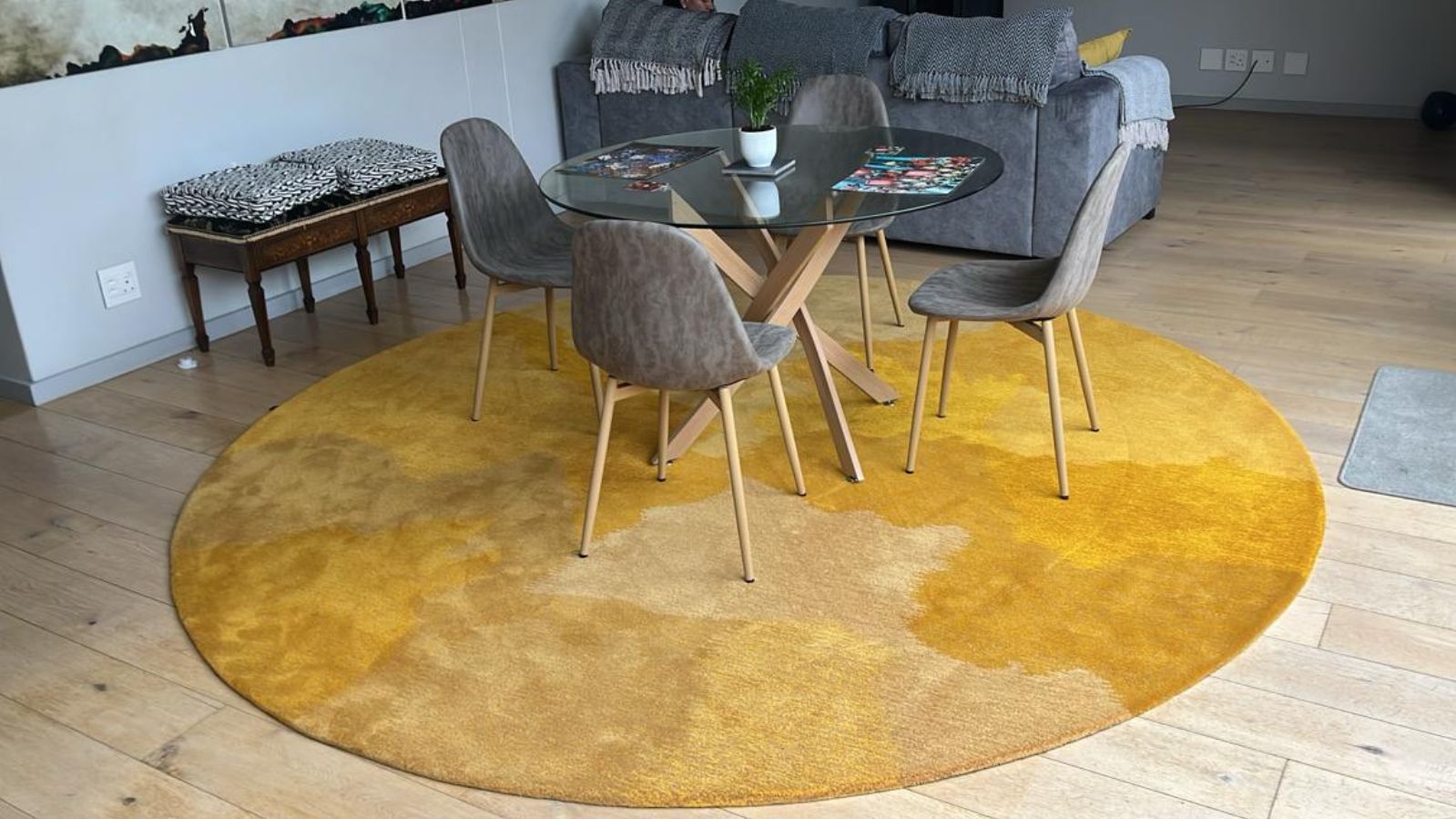
Sizing and Proportions: The 3-Meter Circle Benchmark
Scale is everything when manufacturing a bespoke curved piece. Standard retail outlets often sell small 2-meter accent circles. These small rugs look like isolated floating islands beneath a single piece of furniture.
To properly anchor a space, a 3-meter option showcases the true value of large circular rugs in interior design for premium residential layouts. At a 3-meter diameter, the textile commands its own physical footprint. It allows you to position the front legs of multiple seating elements completely onto the canvas. This creates a grounded, cohesive relationship where every piece of furniture feels connected.
The Craft on the Loom: Engineering the Perfect Curve
Executing a perfect circle or an intricate organic edge requires exceptional precision. A curved border demands a highly disciplined hand on the tufting floor.
The Mechanics of the Tuft
Our team maintains a strict technical standard to deliver our signature, dense premium weight of 5kg of yarn per square meter. Our artisans almost always tuft from the bottom upwards. This direction ensures uniform pile density and structural integrity across the entire surface.
However, some designs call for complex mottling techniques. If a curvy layout demands specific color blending, our team will dynamically shift their approach. They will tuft in accordance with the design lines to create a stunning sense of organic movement within the rug.
Locking the Structural Memory
Standard retail circular rugs often curl or ripple at the edges because manufacturers rush the backing process. A circle or organic shape constantly cuts across the grain of the backing fabric. This makes the textile inherently unstable if left unchecked.
We solve this mechanical challenge entirely while the rug is still under tension on the loom:
-
First Coat: We apply a first layer of specialized latex backing directly to the secure rug.
-
Secondary Matrix: We place a high-quality secondary backing fabric onto the wet latex.
-
Final Seal: We apply a second layer of latex glue to create a permanently bonded sandwich.
The textile then remains fully tensioned on the loom for roughly two days until it completely cures. This two-day curing process locks the structural memory into the flat canvas. It completely eliminates the risk of edge warping before the rug ever touches a floor.
The Art of the Finish: Hand-Sculpted Edges
Once the cured rug finally comes off the loom, it moves upstairs to our finishing department. Here, the ultimate transformation takes place.
Finishing a continuous, 10-meter circular perimeter or a winding organic edge requires a human touch. Standard binding machines cannot handle these profiles. After our custom binding dries completely, our team trims the entire perimeter by hand using scissors.
This hand-sculpting stage is incredibly time-consuming. However, it allows us to pay absolute attention to the final details. It ensures the edges remain pristine and the profile stays clean. Your final textile sits flawlessly as a tailored architectural element in your home.
Design Beyond the Box
Embracing the design psychology of circular rugs in interior design allows you to step away from predictable retail templates. It encourages you to look at your floor plan through an artistic lens. Whether you want to soften an ultra-modern concrete living space or expand a compact layout, a beautifully engineered, loom-cured rug offers a sophisticated alternative.
Explore our portfolio of custom installations to see these fluid shapes in practice, or connect with our studio directly to arrange a complimentary spatial and design consultation.